
Last year’s Right to Rehab Innovation award finalists show what’s possible when physiotherapists lead innovation, as Nina Paterson reports
![FL Jan 26 Reimagining rehab: [Photos: Lorne Campbell/Guzelian]](/sites/default/files/styles/unstyled_max_width_1200px/public/media-image/2025-12/40%2044%20JAN%202026%20Rehab%201200x675px%201.jpg?itok=dnuVQhgb)
The Advancing Healthcare Awards, organised by Chamberlain Dunn, were set up over 20 years ago to recognise innovative healthcare practice across the UK. Last year CSP began sponsoring the Right to Rehab Innovation award, recognising physiotherapists and their teams who are breaking new ground in the design and delivery of rehabilitation.
With the award now open for applications for its second year, CSP assistant director and award judge Ruth ten Hove, along with one of last year’s runners up, consultant allied health professional (physiotherapy) Justine Theaker, and patient Louise tells more.
‘It’s fair to say I was overwhelmed by the number of applications that we had’, says Ruth.
‘We had really interesting applications from members who were making their services more sustainable, equitable, integrated, responsive and best value for money.
‘It was a really good way of starting to get under the skin of what high quality rehab services are doing. And we’re excited to be doing it again this year.’
As a judge, Ruth says she was looking for the same principles that underpin CSP’s Right to Rehab campaign – everyone, everywhere, able to access the rehab they need to live life to the fullest. Rehab that’s person-centred, needs-led, and holistic in its approach. Accessible and sustainable, with empowerment at its heart – with the therapy team just one part of a person’s journey.
Which leads us to Justine Theaker and the Major Trauma Rehabilitation Service in Manchester (MTERS), one of last year’s runners up.
What impressed Ruth was their holistic approach taking account of patients’ emotional, physical and psychological well-being.
Let’s hear more
MTERS was designed to bridge the gap between acute trauma care and long-term recovery, offering enhanced rehab support to people with major trauma and catastrophic life changing injuries.
The collaboration between Manchester University NHS Trust, Northern Care Alliance, Nuffield Health and local universities (Universities of Manchester and Salford, as well as Manchester Metropolitan University) received its initial funding from the We Love Manchester fund, which was set up as a direct response to the 2017 Manchester Arena bombing.
However, Justine notes that from its inception the team was committed to making the offer available to all patients not just those from the attack. They were also determined to leave a legacy – a blueprint that could be rolled out across the UK.
It was this commitment that led to them embedding research studies into the programme from the start. Justine shares, ‘We wanted to evaluate the service and the impact in order to develop a business case to say to our commissioners - look survivors of major trauma are being disadvantaged by lack of effective rehab and management of their severe injuries. Our programme has demonstrated a tremendously positive long-term impact.’
And that decision paid off, with the team able to secure ongoing funding allowing them to continue until Spring 2026.
How the programme works
All patients enrolled have completed routine care and are at least six months post-injury.
The programme provides six months of rehab, offering four hours of outpatient therapy weekly in two two-hour sessions, within community settings. This approach aligns with the NHS Long Term Plan and enables integration with local services.
The team collaborates with community specialists, gyms, and health centres to support patients in adopting new activities into daily life.
‘As a result, individuals who have never accessed a gym before are now maintaining activity beyond discharge,’ Justine says.
The MDT includes physios, occupational therapists, surgeons, sports medicine and biomechanics specialists, alongside wraparound psychological support. Embedded within the Greater Manchester Major Trauma Network, the service can rapidly re-engage patients if difficulties arise, preventing escalation.
Justine acknowledges the vital role of Nuffield in delivering the programme, noting that their support as a charity provided access to outstanding facilities that enabled patients to thrive.
She explains that ‘this partnership has created an opportunity to develop a blueprint for rehab services that could be scaled across the UK, building a lasting legacy from the arena attack. Collaborating with universities to embed research studies ensured lessons from survivors informed the design of a robust, evidence-based service.’
Impact for the individual
Justine notes that: ‘Some of our patient’s report being better than they were before their injuries. They report continued engagement community services and better management of their own health and wellbeing.
‘Our patients are returning to work and can live meaningful lives, which they previously thought were not possible.’
Justine adds, ‘Many of our patients have seen a transformation of their lives since starting the programme, not just for now, but for the future.’
And for sustainable healthcare?
It’s clear the programme is directly addressing the three shifts outlined in the NHS Long Term Plan.
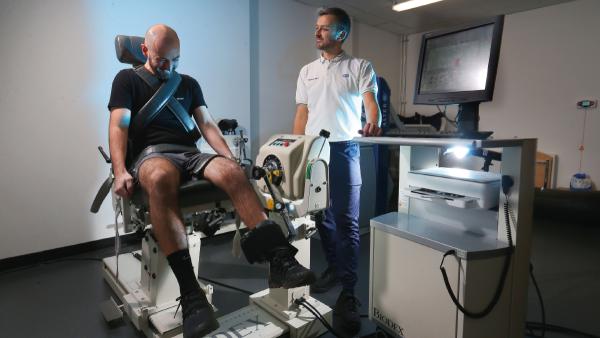
Justine notes ‘MTERS combines community-based delivery with cutting-edge technology to enhance recovery and prevent long-term inactivity. ‘Since 2018, the team has led the shift from hospital-based to community-based rehabilitation, reducing long-term inactivity and promoting recovery.
‘The service also integrates advanced technology, including biomechanics, anti-gravity treadmills, patient records and digital outcome tracking. All of which has positioned the service ahead of national priorities now embedded in the Long-Term Plan.’
Does Justine have any learning to share with others?
‘Teams hold the solutions,’ she says. ‘By moving beyond NHS constraints and thinking creatively, we can implement approaches that deliver superior outcomes and demonstrate clear value for money.
‘To gain support from senior leaders, present evidence-backed proposals with “SMART” objectives,’ she continues ‘Demonstrating clarity and measurable impact is essential when resources are constrained.’
Justine’s final advice is: ‘Use patient feedback to guide service improvement.
‘Our goal is to enhance care, outcomes, and quality of life while contributing to population health, and we need patients to help us achieve this.
‘Support this with robust data and patient stories through videos, focus groups, and interviews. Combine this with staff narratives to highlight job satisfaction, empowerment and subsequent staff retention - both are critical for sustainable service improvement.’
Inspired to reimagine rehabilitation…
- Start with the individual. With an aging population who are becoming more complex at a younger age, with widening health inequalities, think about complexity and community delivery.
- Embed good quality research as well as good quality treatment and interventions with patients.
- Challenge assumptions and expectations. That’s important – particularly for shifting to a prevention first model.
- Think outside the box. Allow yourself to bring physiotherapy’s creativity, problem-solving, and leadership skills to the fore.
- Push back. As independent, autonomous practitioners, don’t be afraid to challenge more.
- Do the sums and look at the whole social return on investment on the CSP’s return on investment calculator.
- Think system-wide and across sectors. The solution is unlikely to be just physiotherapy – it’s the whole multidisciplinary team.
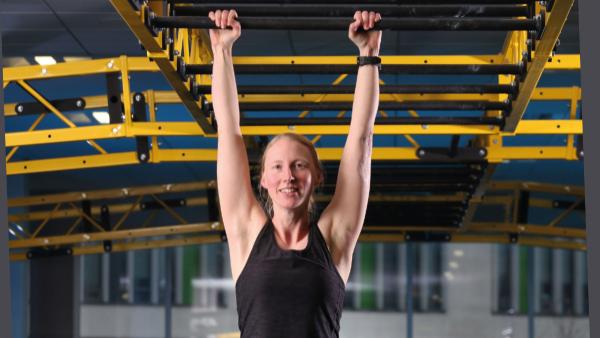
Louise’s story
In May 2022, Louise fell 60 feet from a sea cliff in Orkney after her anchor was pulled free during an abseil. ‘I remember shouting, “Oh no, I’m falling,” and then nothing,’ she says.
The pharmacist hit the rocks before being swept out to sea. Her partner, Allan, jumped in after her while a friend swam round to help until the RNLI reached her.
Louise’s injuries were devastating – she broke her back in six places and her pelvis in seven, fractured both ankles, and suffered an open fracture to her left elbow that later needed a skin graft. ‘The surgeon told me it was the worst fractured pelvis he’d ever seen,’ she recalls. ‘He said I was lucky to survive the surgery.’
Despair set in when doctors warned her, she would never run again and questioned whether she should climb at all. ‘I remember thinking, “Is this really it now?”’ she says.
After four months in hospital and community physio for basic mobility, Louise started at the Major Trauma Rehabilitation Service in Manchester (MTERS).
It was there clinicians asked her what she wanted to get back to. ‘They didn’t lower my expectations - they helped me raise them again,’ she says.
With their support, she re-learned to run, climb and rebuild the life she feared she’d lost. Louise has just completed a half marathon and is back tackling the cliffs of her native Manchester.
‘Rehab changed my life,’ says Louise. ‘Without it, I wouldn’t be doing any of the things I love.’
Inspired to apply?
Already innovating? Apply for this year’s Right to Rehab Innovation award and celebrate your creativity and commitment to the profession’s collective influence on system change. Applications are now open.
Still not sure?
In Ruth’s words, ‘Don’t think that any change is too small. If you feel like you’ve made a difference, to access to the experience of people coming into your service, to the outcomes of your population, whether you’ve shown more efficiency – put an application in.
‘And when it comes to data – you may be reticent to share your data so just remember – the judges just need a summary of your impact. You can even think about it as a trial-run for those conversations you may need to have with the decision-makers. As the MTERS example shows – you need your data to make your case to bring about sustained change.’
Find out more
Number of subscribers: 2