
Find out how physio Subash Sivarasu is preventing unnecessary hospital admissions and helping more patients to thrive at home. Mark Gould reports
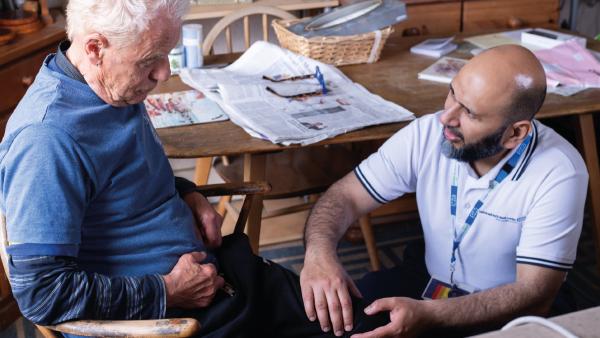
![FLJul26Cover TransformingCare Senior physio Ali Shah with patient James Beaumont at a home visit [Photos: Nathan Clarke]](/sites/default/files/styles/unstyled_max_width_1200px/public/media-image/2026-06/b5966cba-4da3-462e-9256-01daf4e1d738.jpg?itok=s2m4pc5M)
‘Things weren’t going well; we were not meeting demands, staff morale was down, and we were getting complaints from GPs who were unhappy that we were not accepting referrals.’
That is how physiotherapist Subash Sivarasu describes the situation facing community urgent care services in Hillingdon, northwest London, before a major transformation programme reshaped the way care was delivered.
Subash, clinical service manager for adult community services and lead therapist for allied health professionals (AHPs) oversees services including urgent community response (UCR), discharge to assess (D2A), and community adult rehabilitation teams.
These services play a critical role in preventing unnecessary hospital admissions, supporting timely discharge, and helping patients remain safe at home.
![Subash Sivarasu with Sunoj Jacob at Beaufort House, Uxbridge [Photos: Nathan Clarke]](/sites/default/files/styles/half_width/public/media-image/2026-06/0a3878ae-87ed-40c9-a357-4d05c78d5995.jpg?itok=GSi95Zqd)
Operating within Central and North West London NHS Trust (CNWL), Subash and his teams work in one of the capital’s most demanding environments.
Hillingdon comprises areas of socio-economic deprivation, increasing frailty in an ageing population, and the additional impact of Heathrow Airport and its large transient population.
‘We were seeing demand coming from every direction,’ says Subash. ‘The teams were working incredibly hard, but the system was struggling to cope with the increasing demand.’
At the heart of the challenge was the need to meet rising demand while supporting national NHS and local priorities, focused on delivering care closer to home.
Across England, healthcare systems are moving towards integrated working, where health, social care, primary care, and voluntary sector organisations collaborate to provide proactive and personalised care.
Multidisciplinary working
Subash qualified as a physiotherapist and completed a master’s degree in India. He moved to the UK in 2003 and began working in north London as a band 6 physiotherapist in neuro outpatients. Over the last two decades, he has worked across acute hospital and community services, developing extensive experience in multidisciplinary and integrated working.
‘This has given me the depth of knowledge and understanding needed to support people safely at home,’ he says.
He joined Hillingdon in 2023, with a key responsibility of ensuring that patients who could be safely cared for in the community avoided unnecessary hospital admission, while also facilitating safe and timely discharge from the hospital.
However, rising pressures across urgent care pathways were making this difficult.
Subash realised that the existing service model wasn’t sustainable. UCR and D2A services were competing for the same workforce and resources despite having very different operational demands.
‘We showed senior leadership teams with the data set and patient feedback that the way the services were functioning was not meeting demand,’ he explains.
UCR required stronger nursing capacity due to medical acuity, while D2A needed greater therapy input and the need for ring-fenced resources and clearer pathways.
At times, the UCR service had to stop accepting referrals from GPs and ambulance services because of capacity pressures. Staff morale was affected, and frustration was growing among both clinicians and referrers.
Importantly, the transformation work was not just about requesting additional physiotherapy posts. Instead, Subash and his team developed a broader workforce redesign proposal in collaboration with NHS England, focused on multidisciplinary working and integrated care delivery.
Digital innovation
![FLJul26Cover Subash Sivarasu talks with head of Hillingdon Community Services for adults Rakhee Prema at Beaufort House [Photos: Nathan Clarke]](/sites/default/files/styles/half_width/public/media-image/2026-06/b2f14613-5611-4e98-a5ef-f6c004da1080.jpg?itok=uM0sjN7E)
‘We have negotiated for workforce improvement across the whole service so patients could receive the right care at the right time by the right clinicians.’
The introduction of the innovative DocAbode digital appointment and workflow platform, integrated with the existing SystmOne clinical system, significantly improved productivity and operational oversight across the UCR and D2A pathways. ‘The digital integration improved productivity, supported clinical decision-making, and gave teams greater flexibility and visibility across the pathways. It helped us modernise the way we deliver urgent community care.’
The team worked closely with Hillingdon Health and Care Partners (HHCP), which brings together the NHS, social care and community partners. Through collaboration and system-wide planning, the services secured approximately £720,000 of additional funding from HHCP and other sources to support transformation and expansion.
Redesigned UCR and D2A began operating as separate services in September last year. Before the changes UCR managed around eight referrals per day. The service now routinely manages 12 referrals daily, representing a substantial increase in capacity. The D2A service currently operates 48 discharge slots per week, and it is one of the highest levels of D2A new assessment activity across London due to local demand pressures.
The workforce also expanded considerably, growing from nine staff members to 19 within the D2A team, as well as creating a new hospital at home team to manage patients with more complex needs or high medical acuity.
These changes in service delivery across the two pathways led to workforce growth across the integrated teams, including physiotherapists, occupational therapists, nurses, rehabilitation assistants, and support staff.
‘We have increased overall capacity across multiple specialities because demand is not only for physiotherapists or occupational therapists,’ says Subash. ‘The key is having highly skilled multidisciplinary clinicians who can work flexibly and holistically.’
Key to the transformation is the upskilling of clinicians who are trained to undertake broader assessments and interventions traditionally associated with other professions.
‘Nurses can complete mobility or transfer assessments, while physiotherapists can undertake observations, take bloods, liaise with GPs, and escalate concerns appropriately,’ Subash explains.
This integrated model also supports the wider ambitions of neighbourhood working by reducing duplication and improving patient experience.
‘Patients don’t have to repeat their story multiple times to different professionals,’ he says. ‘One clinician can complete a comprehensive assessment, identify risks, and coordinate care quickly.’
Job satisfaction
The benefits extend beyond operational efficiency. Physiotherapists are increasingly playing a central role in addressing health inequalities, frailty, and long-term conditions within local communities.
Many patients supported by the service are older adults living with multiple chronic illnesses, reduced mobility, social isolation, or frailty.
Physiotherapists work closely with wider neighbourhood teams to prevent falls, improve mobility, support rehabilitation, promote independence, and reduce avoidable deterioration. Integrated neighbourhood working also enables earlier intervention for vulnerable populations who may traditionally struggle to access healthcare services.
‘Frailty management and long-term condition support are becoming a huge part of community physiotherapy,’ says Subash.
We are helping people stay independent for longer, reducing hospital admissions, and supporting people in environments where they feel safest - in their own homes.
One of the most encouraging aspects of the transformation has been the growing leadership role of physiotherapists. Subash manages a broad portfolio of professionals while his own line manager is also a physiotherapist overseeing district nursing, palliative care, and wider community services.
‘In the so-called good old days, therapists were often managed by nurses,’ he says. ‘Now physiotherapists, occupational therapists and AHPs are leading complex operational services across community healthcare. It reflects how the profession has evolved.’
Ash James, CSP director of practice and development, says: The transformation in Hillingdon demonstrates the vital contribution physiotherapy and wider rehabilitation teams make to keeping people safe at home and reducing pressure across the system. Subash Sivarasu’s work highlights what can be achieved when services are designed around patient need, supported by multidisciplinary working, strong leadership and use of digital tools.
There is a clear lesson for CSP members. Spot where demand is growing and where national priorities are heading, in this case urgent community response and admission avoidance, and ensure physiotherapy is central to those conversations. By using data, patient feedback and system insight, Subash and his team made the case for physiotherapy as a core part of the solution. However, this progress also underscores a UK-wide challenge. Too often, community services are asked to deliver more with insufficient physiotherapy capacity, creating risk for patients and limiting the shift towards prevention and neighbourhood care.
Physiotherapy is not optional; it is a workforce solution. With the right investment in staff, skills and leadership, services across England can replicate this success and deliver the home first care patients need and deserve.
Number of subscribers: 2