This week the UK Covid 19 Inquiry led by Baroness Hallett published its report on the impact on healthcare.

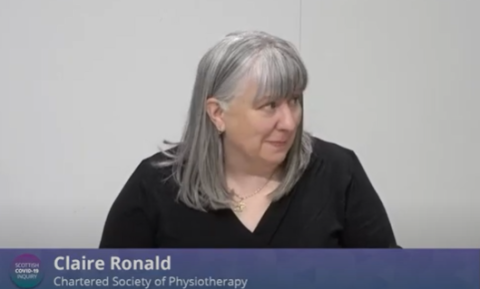
Both the CSP and Long Covid Physio network submitted evidence to the enquiry. Baroness Hallett found that ‘collapse was only narrowly avoided because of the extraordinary efforts of all those working in healthcare across the UK. Their commitment and dedication were remarkable’.
The report recommendations include improving NHS staffing levels and investing in urgent and emergency care capacity.
During the pandemic physios and physio support workers were in the frontline in ICUs. The report highlights the challenges staff faced in this setting. Respiratory physiotherapy was critical to save lives in ICUs. The report quotes figures that more than 500 additional ICU physios would have been needed to expand bed numbers to the levels needed, but notes that there were not enough physios to staff services at the right levels. The CSP in our evidence pointed out that the long-term understaffing in the NHS creates emergency capacity problems. We also highlighted that the system failed to use most of the significant numbers of recently retired physios, private practitioners and physio students who came forward offering support.
The report rightly highlights the impact on patients caused by the inability of the NHS to maintain non Covid services during the pandemic. While services across both the NHS and private sectors innovated with virtual services, only in Wales was there a policy of fully maintaining community physio service. Many physios were redeployed to support other services, or to work on the vaccination programme, but there was a cost for patients of not being able to provide services at normal levels.
CSP members will know only too well the impact this has had on patients with a range of conditions not being able to access physiotherapy or other care and the consequences for their ability to get back to lives well lived.
The report says that the then UK health secretary was in denial about the perilous state of the NHS. Underfunding led to a lack of capacity. The current funding levels for the NHS across all four UK counties has been only marginally above the level needed just to keep services as they are and in some areas there are significant budgetary problems. Unless governments increase resources we face the prospect of a repeat of the crisis faced during Covid when the next pandemic emerges as it will do at some point.
The report highlights the problem healthcare professionals had accessing appropriate personal protective equipment (PPE). Many NHS staff who died of Covid probably contracted it at work. The report establishes the higher level of risk Black, Asian and other minority ethnic staff faced. This was something the CSP raised during the pandemic. Unlike paramedics and nursing, we saw no physios working in the NHS die from Covid. But there were instances of CSP reps and staff having to battle to get appropriate PPE for members in high-risk contexts. We also had to educate the healthcare system about the variety of sectors physios work in to ensure all physios and physio support workers were eligible for vaccination before the universal rollout.
The physiotherapy community was, however, not immune from the awful impact of Covid. Tragically, some members died from Covid and many others lost family, friends or colleagues. Others were hospitalised and some have had long-term impacts. Long Covid may affect two million people across the UK. Anyone who has seen the impact of Long Covid, as I have with a close relative, will know it can be life-changing.
While the initial NHS response was to develop Long Covid rehab services, these were patchy and often short-lived. The report’s assertion that ongoing support for those with Long Covid is available is not always the experience people have. As with any long-term condition, the CSP supports a converge-diverge approach to rehab service design. We need specialist services for when patients need to access specialist support, and multi condition community rehab services for step down care when appropriate.
It remains to be seen how government and healthcare bodies will respond to the report. It is clear that we need to see commitment to an expanded physiotherapy workforce and funding for NHS services to have the expanded capacity needed to deal with future pandemics. We only just managed the Covid 19 crisis without healthcare collapsing. Hoping the same would happen in future is not an acceptable strategy.
Number of subscribers: 2