Alahna Cullen, trainee advanced clinical practitioner and physiotherapist in stroke rehabilitation, reveals how her team achieved a 26 per cent reduction in care needs on discharge - and secured funding to keep the service going.

Over the last year, I’ve been leading a project at University Hospitals Dorset funded by SQUIRE (Stroke Quality Improvement in Rehabilitation). Its aim was to help stroke patients return home sooner – even when they are still at a very dependent stage of their recovery. Traditionally, this kind of intensive rehabilitation would only have been possible in hospital.
Our project tested whether we could deliver the same level of therapy in people’s own homes, with two therapists supporting patients to stand, take steps and practice carrying out daily activities.
Throughout the year we were able to support 57 patients’ home from the stroke unit, on average, 13 days earlier than they previously would have.
The patients were seen for therapy on average four to five days of each week and the data showed a 26 per cent reduction in care needs on discharge when compared with a similar cohort of patients before the pilot commenced.
It’s been a powerful and rewarding experience, both for me and for the people we’ve supported. Patients told us that being at home, surrounded by family and familiar routines, gives them motivation to keep improving. Patients sleep better, and families say they feel more involved when having their rehab at home.
Rehabilitation really does give people their lives back.
Being able to deliver rehabilitation at home really enables patient centred care. We can identify clear goals and enable true functional practice that is very difficult to replicate in a ward setting.
Measuring impact
The results have been clear. Our pilot showed that patients could go home on average, 13 days earlier, with no loss of intensity in their rehabilitation. They were still able to achieve their goals, but in a setting where they could start rebuilding their lives straight away.
This had a wider impact on our ability to deliver the stroke care in hospital for the patient that require it. We were able to free up inpatient beds that can be used for patients requiring medical intervention and rehabilitation that cannot be delivered at home.
In terms of financial savings, the project estimated an £807,000 saving in bed days which when factoring in the cost of the service, still gave an overall saving of £480,000 in one year.
The team adapted really well to the new ways of working and the positive impacts on the patients really enabled wider benefits to staff morale. The team both in the hospital and in the START team felt confident to discharge patients home knowing they were going to continue to receive the rehabilitation they required. The ability to discharge patients earlier also helped to relieve pressure from our inpatient unit by reducing the number of patients that required inpatient therapy. This in turn benefits staff wellbeing and help to reduce burnout.
Most importantly, this was supported by patient feedback. Many told us it ‘felt like the right time to go home’, describing how it was ‘a better environment for your recovery, enabling greater independence and opportunities for rehabilitation’. Patients also said that at home they were ‘able to sleep better, eat your own food and be comfortable’.
The way therapy was delivered mattered too. They highlighted that ‘the frequency of the input was important, and this enabled you to see tangible progress’. And throughout, they valued the expertise of the staff, saying that ‘input from the specialist and skilled team was important and this was excellent’.
This feedback enabled us to understand what was important to our patients and enabled us to shape the business case for the future.
David’s story
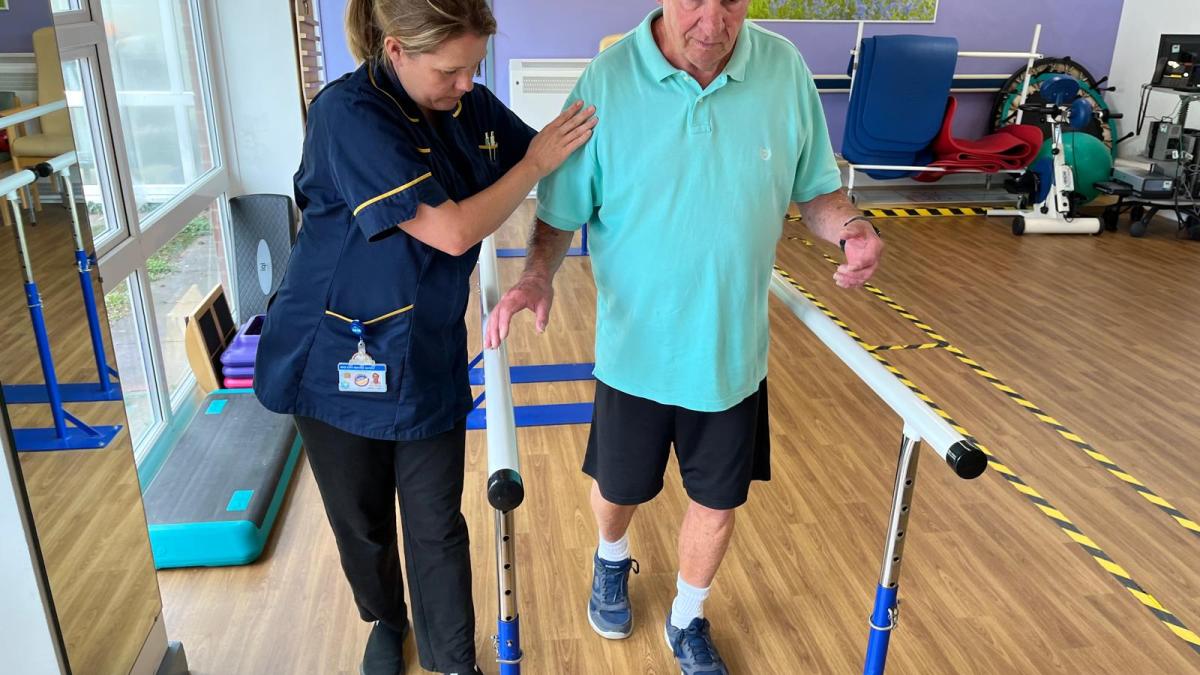
One of the people I worked with was David. When I first met him, he was struggling with complicated medical issues, and the hospital environment was making his recovery even harder. Our challenge was to find a way to provide the right level of care and rehab outside of the hospital.
With a lot of determination on his part, and support from our team, he went from being bedbound to walking 10,000 steps a day, managing stairs, driving again, and even planning to return to work.
David and I feature in a new short film created as part of the Right to Rehab campaign. In it, he shares how twice his family were told to say goodbye – but now he’s thriving at home and living independently again. For me, seeing him a few months on from our input, reunited with his family, and doing the things he loves, has been a really special moment in my career.
'David went from bedbound to walking 10,000 steps a day.'
Building a business case
Following the positive impact of our pilot, we have successfully submitted a business case for ongoing funding. We will now continue to have a dedicated team of therapists working in this way, supporting more patients to leave hospital sooner and continue their rehab at home.
As the project was coming to a close, it didn’t feel right that this service would potentially have to stop. Patients would remain in hospital longer or face the reality of being at home on a waiting list for standard community therapy as their needs didn’t fit the usual early supported discharge criteria.
The success of this business case has enabled this transformative rehabilitation approach to start to become mainstream. For patients, it will mean having the choice to return home sooner when previously that wasn’t always an option.
As we embed the team once again, we hope to reach out to more patients and develop new innovative ways of ensuring effective rehabilitation is delivered at home and within the local community.
I hope that we can share the outcomes of this project widely to enable more services to develop in this way.
Why rehabilitation matters
Rehabilitation is about so much more than physical exercises. It’s about enabling people to regain independence, return to the things they love, and rediscover who they are after life-changing events like a stroke.
As physiotherapists, we get to be part of that journey. It never feels like just a job – it’s a passion. I have experienced the power of rehabilitation in many patients lives, but all too often the access to rehabilitation is limited or unfortunately not accessible.
This has far reaching consequences, not only for the patients and their families, but to communities and other health and social care facilities that are required to support patients who face the sad reality of living more dependently.
Limited rehabilitation can cause secondary complications directly because of the limited access to rehabilitation. This can include moving into residential care homes, further deterioration in mobility and function, psychological decline and reduced sense of worth. Sufficient rehabilitation has been so powerful throughout my career and that is why I continue to do what I do.
We can be the patient voice when they are not always heard.
David’s story is one example of what’s possible. But many more people deserve the same chance. That’s why I’m proud to stand behind the Right to Rehab campaign: because everyone should have access to life-changing rehabilitation, no matter where they live.
Number of subscribers: 4