



























The Chartered Society of Physiotherapy The Chartered Society of Physiotherapy

Latest news

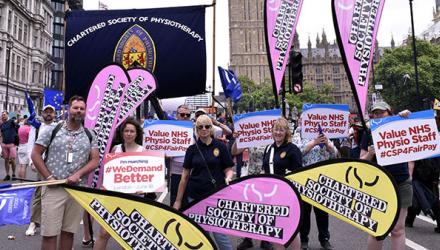
Keep up to date here with the latest news about the current pensions campaign.

Ballot result

1 May 2012

CSP members have voted to accept changes: NHS members accept reluctantly changes to their pension scheme.

Consultative ballot

12 April 2012

The CSP urges members working in the NHS and related social enterprise companies in England, Wales and Northern Ireland to use their vote in the consultative ballot: Use your vote in pensions ballot, says the CSP.

NHS Scotland

30 March 2012

Negotiations on changes to NHS pensions for staff in Scotland may continue until the end of the year, but the final new scheme will be implemented by 2015, Scotland’s health minister tells NHS unions: Health minister opens talks on NHS pensions for Scottish staff.

Proposed final agreement

9 March 2012

Negotiators from the CSP and the vast majority of other health unions have agreed to take a proposed final agreement on the NHS Pension Scheme back to their union memberships for consultation: NHS pensions - proposed final agreement.

CSP works to clarify pensions offer

26 January 2012

The CSP has pledged to provide further clarification and answer the queries from members on NHS pensions as it continues talks with the government to hammer out outstanding issues to be included in a final offer document.CSP works to ensure members make informed decision on NHS pensions.

Member vote on pensions

19 January 2012

The CSP is preparing to consult in an individual ballot of members on proposed changes to the NHS pension scheme, following the industrial relations committee (IRC) meeting on 18 January - read the news story in full: Members to decide on pensions offer.

Member consultation

6 January 2012

The CSP is firming up plans to consult members on the final proposals on NHS pensions put forward by the government last month - read the news story in full: Plans to consult members on pensions offer move forward.

Additional ballot results

5 January 2012

Results from the additional ballots in Northern Ireland, Scotland and England are now available.

Read the full details in a statement from Lesley Mercer, the CSP Director of Employment Relations and Union Services, in the additional ballots page.

NHS Pensions Offer: what's happening

22 December 2011

Following the government's offer on 19 December, the CSP has agreed, alongside other health unions, to consider the government's final proposals and put these to the Society's Industrial Relations Committee (IRC) in January reports Peter Finch, CSP assistant director of employment relations.

The IRC will decide if we accept or reject the offer, taking into account feedback from members and consider arrangements for membership consultation.

The main elements of the proposals are:
  • confirmation that pension benefits earned up to April 2015 (known as accrued rights) will be protected
  • ensuring scheme members who are less than 10 years from retirement (ie their current normal pension age) as at 1 April 2012 are protected from the changes, except the government imposed contribution increases.
  • this protection also applies to members with special class status and mental health officers
  • further limited protection for members who are currently aged from 46.5 (if in the 1995 scheme), 51.5 (2008 scheme) and 41.5 (special classes)
  • a pension scheme based on career average with an accrual rate of 1/54th (this is the rate at which your pension builds up for each year of service)
  • normal pension age linked to the state pension age in future
  • future pension increases linked to the consumer price index
  • an extension of the Fair Deal agreement so that members transferred from the NHS under TUPE arrangements can retain membership of the NHS Pension Scheme, with a commitment to review if this could apply to AQP situations
  • average member contributions by April 2014 of 9.8%, with tiered contributions.

What it means for you

So what is on the draft Heads of Agreement, reached at a meeting of unions, including the CSP, with NHS Employers and Department of Health officials on 19 December? How does it impact on CSP members? And what is different from the original proposals?

It is important to remember that any new scheme would be introduced on 1 April 2015.

The latest changes in detail

Retirement age
  • Protection for members less than 10 years away from their normal pension age; this will apply to any CSP member aged 50 or above who are members of the 1995 scheme.
  • Protection (as above) for members with special class status who are over 45.
  • Further tapered protection for staff who are between 10 + 13 ½ years from their normal pension age which will mean they switch to the new career average scheme between 2015 and 2021. This additional partial protection also applies to members in special classes.
  • Recognising the physically demanding jobs some staff have, a tripartite review between unions, NHS Employers and the Department of Health to address the implications of working longer.
Contributions
  • The government announced, before the end of negotiations its decision on contribution increases which will take effect from 1 April 2012.There will be no increases during that year for members whose whole time equivalent pensionable pay is below £26,557 (AFC paypoint 22) this will apply to all members in pay bands 2,3 and 4, most members in pay band 5 and some members in 6.
  • For those staff above £26,557 the increase will be between 1.5% and 2.4%
  • There will now be discussions on how further increases will be distributed in years two and three.
Scheme Design

An accrual rate of 1/54th in a career average scheme for service after 1 April 2015.The original offer from the government was an accrual rate of 1/65th so at least for this element this represents an improvement of 20% in the value of your pension for each year in retirement. Members will be aware the original proposals which flowed from the Hutton review in March 2011 suggested accrual rates of 1/80th or even 1/90th.

Fair deal
  • Existing members will be able to stay in the NHS Pension Scheme if they are subject to a TUPE transfer into the private or voluntary sector following a competitive tendering exercise. There is also a commitment to look at how this might be extended to include members working outside the NHS as part of an 'Any Qualified Provider' arrangement.

The draft Heads of Agreement also stipulates that should overall scheme costs increase in the future, the first additional 2% of any increase will be borne by NHS employers.

Finally the government has offered a 25 year guarantee on no further changes to scheme design, benefits or contribution rates, although how this 'guarantee' will work is not yet clear.

CSP's overall assessment of NHS pension offer

The offer is a very complex one and the health unions are continuing to meet with the Department of Health and NHS Employers to clarify some of the detail and consider the areas for further discussion set out in annex A of the draft Heads of Agreement.

Whilst not the deal we would have wanted, this is a better deal than that offered at the start of the negotiations and in our view (and also that of other unions) the best we can achieve through negotiation.

What is certain is that the action taken by CSP members on 30 November did make a difference both in terms of the revised offer made by the government on 2 November and subsequent improvements secured during lengthy and complex negotiations.

It was unfortunate the government continued to change its position on what could be negotiated, imposed ever changing deadlines and even at the last stage, late last week demanded negotiations be concluded by Monday (19 December) threatening to impose its original offer if they hadn't been!

Since the strike action on 30 November there have been five formal meetings between unions, NHS Employers and Department of Health and a further meeting with the Secretary of State for Health, Andrew Lansley.

These negotiations have taken place against the backdrop of increasingly gloomy economic news. The crisis in the Eurozone, the latest forecast from the Office for Budget Responsibility predicting a pension scheme deficit within three years and recent intervention from John Hutton (author of the Hutton Review on public service pensions) who stated the economic assumptions which formed the basis for his conclusions are likely to be "too optimistic."

Nevertheless, hopefully members will see that progress has been made in a number of areas and the industrial action ballot and strike action of 30 November did make a difference. Until the CSP and other unions embarked on the balloting process, there had been no previous movement whatsoever by the government in the preceding months of 'negotiation'.

The significant increase in the accrual rate, the 10 year protection (including that for our own members with special class status) and the review for staff who will have difficulty in working beyond their current normal pension age represents real progress. Against this, the contribution increases, shift from a final salary scheme, and automatic link to state pension age are areas the Government has refused to amend its position on.

NHS Pension Offer - Next Steps

The Society's Industrial Relations Committee will be meeting on 18 January to give full consideration to the draft Heads of Agreement, its implications for CSP members and finalise arrangements for consulting members.

In the meantime, the small number of additional ballots for industrial action which are currently underway will continue so the members involved are in the same position as other members when considering future options.

None of these options will be easy.

The CSP needs to clarify precisely the position for members in Scotland and Northern Ireland who are members of separate schemes.

We expect ministerial statements in the near future and will advise members of these as soon as we receive them.

All unions have agreed the draft Heads of Agreement is the best which can be achieved through negotiation. The choice we face therefore is between accepting this final offer or embarking on sustained industrial action. In the face of an intransigent and hostile government, simply saying 'no' and hoping further negotiations deliver some improvements is unfortunately not a credible course of action.

Members will undoubtedly feel anger at this final offer from government and be deeply cynical about any 25 year 'guarantee'. But there is no doubt the improvements we have achieved were only because of the determination and support CSP members showed on 30 November. You demonstrated that you are not willing to be pushed around and should not be taken for granted.

The Society will be publishing further information and analysis in January to get to help members understand what the proposals will mean.

CSP response to the government proposals for CARE

9 November 2011

Union experts are questioning figures produced last week by the chief secretary to the Treasury.

The Treasury produced examples on November 2 that suggest we will be better off under the government's pensions proposals.

The CSP believes, along with other unions, the government is using misleading data. The Treasury examples suggested that an NHS nurse with a full career retiring on a salary of £34,200 would receive a pension of £22,800 a year under the proposed scheme, while under current arrangements they would only get £17,300.

But analysis by trades union pension experts found that this example was based on a comparison of a nurse working for 43 years and retiring at age 68 in the proposed scheme and a nurse working for 35 years and retiring at age 60 in the current scheme.

So under the proposed scheme the pension quoted involves working and contributing for eight years more and receiving the pension for eight years less.

The pensions experts have calculated that if a like for like basis of comparison is made, based on working to the same age and the same length of service, then the proposed scheme produces worse benefits at every age up to 68.

Retiring at age 60, at the top of pay band 6, earning £34,200 the nurse would be 40 per cent worse off and at 65 the nurse would be 20 per cent worse off.

The government has also claimed that under transitional proposals those ten years or less from retirement age are assured there will be no detriment to their retirement income.

Trades union pensions experts state that, when you include the loss of purchasing power during retirement on account of the indexation change to the lower Consumer Prices Index (CPI) measure of inflation, the change could reduce the value of total pension income paid during a typical retirement by a further 11 per cent.

The goverment also failed to mention that the nurse and many other public sector workers including physiotherapy staff will face a 50 per cent increase in their contributions, costing the nurse a further £1,000 a year gross, or £65 a month after tax.

The fact is most NHS workers will not get a pension anywhere near this maximum full-time service example, and many will have lower pay than the qualified nurse he has focused on, but all will suffer similar proportionate losses to those he is trying to conceal.

Currently, the average pension received by NHS workers is around £7,500.

CSP's response to government comments that there will be protection for members of public service pension schemes who are 10 years off retirement

8 November 2011

The CSP has not yet had the chance to discuss the detail of the government’s revised proposal, and it has not been agreed, so it is wise to treat anything at this stage with a degree of caution.

We are looking at the detail of the ‘offer’ and its particular implications for CSP members and hope to have further information soon.

As we understand it at this stage, what the Government is currently proposing is that all those who will be 10 years from retirement on 1 April 2012 will retain the right to retire on their full pension.

If you had the right to retire at age 55 on a full pension because you have special class status then we believe that you will retain this right, but we cannot give a definitive answer at this stage.

However, it should be remembered that the majority of our members will still be detrimentally affected by the work longer proposals, and everyone will still be affected by the increased contributions (due to start in April 2012), the change to a career average scheme, and the change from the Retail Prices Index (RPI) to the CPI as a means of inflation-proofing pension payments.

We are therefore urging everyone to vote yes in the ballot.

CSP statement in response to the proposals of 2 November 2011

4 November 2011

At the meeting Treasury ministers put forward proposals to improve the rate at which a pension would build up under any new career average scheme, and better transitional arrangements for members approaching retirement.

The TUC and public sector unions, including the CSP, recognised this as a shift in the government’s position as a direct result of the strength of feeling and determination shown by public sector employees and the groundswell of support for the planned day of action on 30 November.

Members will be aware that the Society’s core concerns on the pension proposals fall into 4 areas:

  • Contribution increases
  • Rise in pension age
  • Design of any future scheme
  • Lower uprating of pension payouts (RPI to CPI) 

Today’s proposals represent an improvement in only one of these four areas, namely the rate at which members’ pensions would build up in a career average scheme.

This leaves significant areas in which the government’s position remains unchanged.

The proposals and their detailed implications will now be considered in detail within NHS-specific talks and the CSP will play a full role in this process.

As indicated from the start, the Society along with other public sector unions remains committed to trying to reach a negotiated settlement.

Nonetheless, unless there is further real progress in the weeks ahead, there is no alternative but to continue with the CSP’s ballot for action on 30 November.

Commenting on today’s developments Alex MacKenzie, chair of the Society’s Industrial Relations Committee, said: 'It is now even more important that we send a strong message to the government by getting a resounding ‘yes’ vote in our ballot.'

Further information

See the timeline page for details of all the key developments leading to this offer.

Links

Your message will be:

I thought you might be interested in this page on the Chartered Society of Physiotherapy website.

Tagged as

Advertisements