All minorities are now officially equal in the NHS and other physiotherapy workplaces – but is one less equal than others?
Few would dispute that there has been real progress in equality for gay and lesbian physiotherapists over the last 15 years.
Similarly, the NHS can hardly be painted as the last stronghold of hostility towards homosexuality in the UK.
Plenty of religious groups, media outlets and sporting organisations – ‘nice’ golf and tennis clubs as much as their football counterparts – continue to compete for that title.
However, there is some evidence that homophobia, often of a supposedly relatively benign or subtle kind, still exists in the NHS – and that it is treated less seriously than harassment or discrimination on the grounds of race, gender or faith.
Assessing its scale and impact is a challenge
The Health Professions Council does not specifically keep a record of cases where homophobia is suspected, though the CSP does note such discrimination.
In 2003 the Employment Equality (Sexual Orientation) Regulations made it unlawful to discriminate against a person in employment in the UK on the grounds of sexual orientation.
This has been replaced by the 2010 Equality Act
However, CSP national officer Saraka Keating is clear that some physios feel pressured into hiding their sexuality – often because of the workplace culture – while others have encountered open hostility from colleagues or patients.
‘Gay and lesbian people talk about feeling the need to be discreet about their sexuality.
Some say they have been very lucky with no problems with colleagues while others report difficulties.’
Some might feel that sexuality is a personal matter that should not be discussed at work.
However,in most workplaces staff talk about their partners, families and weekends or holidays.
If a gay or lesbian person is unable to participate in such discussions this will affect his or her working life.
Adopting an informal version of the ‘don’t ask, don’t tell’ policy, which was recently discarded by the US military, also leaves open the possibility of homophobic ‘banter’ and ‘humour’ being voiced by employees who are unaware that a gay person is present and likely to be offended.
Negative labelling
One physio found a large hospital was a more comfortable work setting for gay and lesbian physios than community settings.
‘My own experience of working at a hospital was that people are very accepting,’ she says.
‘Hospitals are quite diverse places anyway. However, when I moved to a community setting several years ago I was warned by a gay friend that there is a lot of prejudice [among members of the workforce].
Soon she and a lesbian colleague were being labelled ‘stroppy lesbian troublemakers’.
Publications such as the CSP’s updated Equality and Diversity Toolkit and a 2007 Stonewall report on homophobia in the NHS highlight cases of blatant homophobic discrimination (Hunt R et al. 'Being the gay one', Stonewall 2007).
They also reveal a workplace culture in which homophobic jokes or ‘banter’ are seen as acceptable in a way that ‘humour’ based on racism or sexism would not.
The publications also paint a picture in which gay and lesbian employees adopt strategies to protect themselves and their careers – often based on hiding their sexual orientation and ignoring such behaviour.
In one of the many minor ironies that characterise homophobia in the NHS workplace, Frontline heard from a physio (a lesbian) who says she faced homophobic comments while delivering equality and diversity training based on the CSP toolkit.
Healthy debate
Referring to a news story about equality, a physio at the training event said gay people were being ‘touchy’.
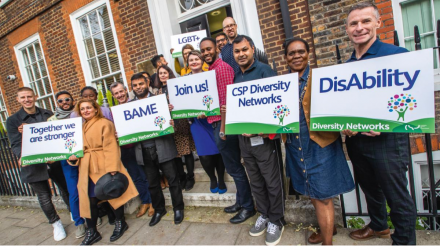
All this might explain why so few gay and lesbian physios were willing to speak to us on the record for this article and why the CSP’s own Lesbian, Gay, Bisexual and Transgender Network (LGBTN) attracts just a handful of members to its meetings - despite having a membership of more than 300.
The CSP toolkit, written by Ms Keating, refers to a member’s concern that certain comments ‘were homophobic’ during debates at a CSP Annual Representative Conference.
Ms Keating cautions against reading too much into this.
‘A union is a reflection of its members and that sort of thing happens in any large group of people.
In a way it’s healthy to have people give their views, debate them and change minds.’
The motions at the conference were carried overwhelmingly.
One motion deplored the presence of just one NHS organisation in the 2009 Top 100 Employers list, compiled by the respected gay rights and equality group Stonewall.
Two years later some seven NHS trusts in England had made the grade, a figure replicated in Stonewll’s 2012 list which was published in January.
Though one trust – Sussex Partnership NHS Foundation Trust – came a creditable fourth in the list, Ernst and Young, a professional services company, the Home Office and Barclays Bank did even better.
Stonewall health officer James Taylor is not surprised that the NHS has been under-represented on the list in the past.
‘The NHS has been one of the poorest performing sectors in the Stonewall Workplace Equality Index.
We know from our research into the experiences of lesbian, gay and bisexual (LGB) staff in the health and social care sectors that [they] both experience and witness homophobia and homophobic discrimination against LGB staff and patients.’
‘Silent suffering’
Mr Taylor accepts the situation is improving, in part through legislation such as the 2007 regulations and the Equality Act 2010. Concerns remain over the issue of ‘silent suffering,’ he says.
‘The frequent “invisibility” of LGB issues in the NHS can be perceived as a factor [in] not complaining.
The large majority of staff would not have a problem reporting racism from other staff or from patients, and trusts need to have effective mechanisms in place to ensure all staff can recognise homophobia and understand how to challenge it and how to report it.’
The visibility issue strikes a chord with Lee Matthews, a band 7 musculoskeletal (MSK) physio with North East London NHS Foundation Trust who is the LGBTN’s co-convenor.
‘People do not feel as comfortable tackling homophobia. While some comments might be subtle, or supposedly humorous, they can reinforce negative stereotypes and hatred towards a minority group.
‘The best way of not making homophobia an issue is to be visible. In my experience, the sooner you come out at work, the easier it usually is.
‘I worked in an office where there was a lot of homophobic “banter” from two of the guys.
I really didn’t feel comfortable about being openly gay in those circumstances.
What I came to realise was that their behaviour was unacceptable. If you create a hostile atmosphere where homosexuality is ridiculed then how can people be open about their sexuality in the workplace?
‘There are worse places to work and the NHS has policies and procedures in place but I am not sure that has changed attitudes and homophobia is often not challenged.’
Comments ‘brushed off’
Mr Matthews acknowledges that when he hears a homophobic comment from patients he tends to ‘brush it off’.
Recalling an incident in which a woman patient (apparently inspired by her particular interpretation of Christianity) referred to a ‘dirty gay’ who had featured in a newspaper article, Mr Matthews said: ‘I treat it as ignorance on their part.
They are entitled to their own beliefs as long as they do not bring them into the workplace in that way.’
As the CSP Equality and Diversity Toolkit makes clear, people are entitled to have their religious views respected at work. The two strands of diversity can spark tension, however.
For example, the 2007 Stonewall report quoted a podiatrist and lesbian who was pointedly told by her new manager that she was a ‘Christian first’ and ‘an NHS manager second’.
Ms Keating says managing potential conflict or prejudice between involving two minority groups reflects on the quality of management and workplace culture.
‘It depends on good practice in the workplace and whether there is a general equality culture.’
The CSP toolkit notes: ‘Some religions do have strong views concerning sexual orientation but most do not advocate persecution of people because of their sexual orientation.’
Equality between the equality strands in other words.
Under the Equality Act, which came into force in October 2010, it is unlawful to treat people less favourably due to their sexual orientation, perceived sexual orientation, or the sexual orientation of those they associate with.
It applies to all organisations, not just the NHS.
See www.equalityhumanrights.com
For recently updated information on the CSP’s training tool kit (for members only) see www.csp.org.uk/publications and enter ‘equality and diversity toolkit’.
Impact of homophobia in the workplace: iCSP discussion
We received nine comments after a request appeared on the Lesbian, Gay and Transgender discussion group on the CSP website.
These are some of the responses, which have been edited. The respondents were happy for their comments to be printed but wanted to remain anonymous.
- I came out whilst a student in 1989 so it was a very different time. I remember my first work Christmas do with my partner.
- It was only then that I discovered how other staff felt about me.
- I was surrounded by a small protective band of friends who knew what had been going on (I didn’t) whilst the rest of the department stared at the new fruit!
- The Superintendent 1 was a well respected physio and manager and she and her husband made a bee-line for us as soon as she arrived so sending a strong message to everyone.
- Attitudes have changed over the years but this can be outward tolerance rather than inward acceptance or disinterest because it’s not an issue.
- I remember saying at an equality seminar at this same hospital that I hadn’t experienced any prejudice as a gay man but the truth is it had been so subtle I hadn’t recognised it or rather, hadn’t wanted to recognise it!
- The prejudice is subtle – everyone else can talk about their relationships but when I do, people look uncomfortable and change the subject.
- Occasionally people surprise me by their acceptance and support.
- When things are going well – it’s hard to suppress being madly in love – everyone else doesn’t need to.
- When it’s going badly – I feel like I’m portraying a negative side of gay relationships if I say anything...but ups and downs happen in any relationship.
- So suppressing who I am is a strain - with patients I accept that, but with staff/ ‘friends’ I am disappointed that this still exists.
As a manager I make a point of being out. This has been helpful for others to come out themselves - one woman didn’t want anyone else to know because her colleagues were homophobic – nice to me to my face but said things behind my back – so she wouldn’t come out and chose to leave.
I agree that things have moved on since I qualified 20 years ago, but it is present in obvious and subtle ways.
I have always been ‘out’ at work and have never hidden my sexuality or the fact that I have a partner to my work colleagues. With patients I had to learn to play ‘professional’ (which ultimately means playing ‘straight’) as much as possible.
However, I am now beginning to question whether I should conform to heterosexual normative values.
There are still incidents of homophobia that are more subtle.
For instance the sniggering in the back of the classroom when I say something a bit ‘camp’ – are the audience laughing with me or at me?
My opinions are ignored in meetings only to be accepted when a male heterosexual colleague raises it sometime later.
I’m not invited to the dinners [or] gatherings with colleagues which are privileged for heterosexual couples (so they can talk about ‘normal’ things like the children, family holidays etc.)’
I’m probably starting to sound a bit bitter and cynical, and normally dismissed by others as: ‘don’t be silly, I am sure it is not intentional’.
That’s often the point – it is not intentional and therefore ‘accepted’ as OK. I am glad this debate has been raised.
Homophobia at work: What to do
How you respond to homophobia at work might be influenced by a number of factors.
For example, if you are gay, lesbian or bi-sexual, are you are open about your sexuality in the workplace?
Options you might consider include:
- Challenge homophobic remarks, jokes or behaviour by colleagues or patients (the nature and context of the activity might determine how forcefully and openly you do this)
- Report such behaviour, particularly if it persists, to your CSP steward and to relevant managers
- Raise the possibility of additional diversity training for the team at team meetings or with managers
- Consider using grievance procedures after discussions with your CSP steward in cases of harassment or discrimination
- Remember that both direct and indirect discrimination on the grounds of sexual orientation are illegal and the ultimate recourse is to go to an employment tribunal.
- As well as ensuring discrimination does not take place, employers are required to protect workers from harassment – from colleagues and third parties such as service users.
Delicious
Digg
Reddit
Magnoliacom
Facebook
Technorati